

Atlas Mountains & Dades Valley: A Scenic Road Trip Through Morocco

If there’s one road trip in Morocco that feels cinematic from start to finish, it’s the drive through the Atlas Mountains to Dades Valley. This isn’t just a transfer between destinations. It’s a full-blown experience. One moment you’re leaving behind the golden dunes of the Sahara. The next, you’re winding through mountain passes, dramatic gorges, and landscapes so surreal they make you question whether you accidentally drove into a film set.
Welcome to one of the most spectacular drives in Morocco.
Driving Through the Atlas Mountains
The Atlas Mountains stretch across Morocco, Algeria, and Tunisia, dividing climates and cultures. In Morocco, they form a dramatic barrier between the Atlantic coast and the Sahara Desert.
As we began the ascent, the road started folding in on itself like a ribbon tossed by the wind.
Hairpin bends.Cliffside stretches.Valleys so deep they look carved by giants.
Then, suddenly, you reach a plateau near the summit.
Silence.

The kind of silence that makes you whisper without knowing why. Geologically speaking, the Atlas Mountains are ancient with some formations date back over 300 million years to the Paleozoic era, when Earth’s continents were still colliding and reshaping themselves. These mountains have survived oceans, tectonic collisions, glacial periods, and shifting civilizations.
No wonder they feel like they’re carrying stories.
A Landscape Shaped by Time (And Legend)
Science tells us the Atlas formed through multiple tectonic compressions between the African and Eurasian plates.
But legends? They’re better.
The Legend of Atlas the Titan
In Greek mythology, the mountains were named after Atlas, the Titan punished by Zeus and forced to hold up the sky. Some believe the peaks are his body turned to stone, still bearing the heavens.
Stand at a high pass and look at those ridges.
It doesn’t feel entirely impossible.
Berber Folklore of Giants
Local Amazigh (Berber) stories speak of giants whose tears carved valleys and whose grief split the earth. In Morocco, geology and poetry coexist comfortably.

Berber Villages & Mountain Life
The Atlas isn’t empty wilderness.
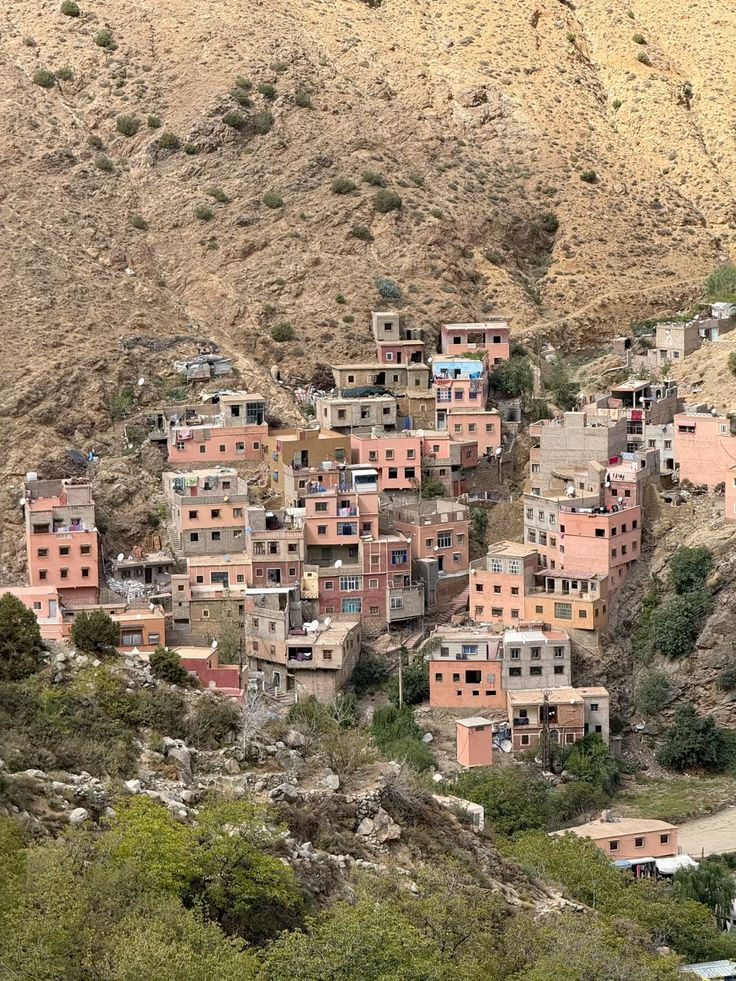
Mud-brick villages cling to hillsides as if gravity is optional. Donkeys still transport goods along narrow paths. Terraced fields patchwork the slopes.
We stopped at small community cooperatives where Amazigh women produce argan oil using traditional grinding stones is a labor-intensive process passed down through generations.
Another stop introduced us to Moroccan mint tea preparation. The aroma alone was enough to convince us we needed at least three extra boxes to take home.
It wasn’t about shopping.
It was about connection.
Seeing the craftsmanship behind every rug, bottle, and ceramic piece changes how you view Moroccan culture. These aren’t souvenirs. They’re stories woven into fabric and pressed into oil.
Dades Valley – Morocco’s Grand Canyon
Leaving the higher passes behind, the landscape began shifting again.
Red cliffs rose dramatically. The road narrowed. The air warmed.
We were entering Dades Valley.
Often called the “Grand Canyon of Morocco,” Dades Valley was carved over millions of years by the Dades River cutting through layers of rock. The result?
Steep gorges.Layered sandstone formations.Cliffs glowing in shades of red and amber at sunset.
It’s the kind of place that forces you to pull over every five minutes just to stare. One of the most iconic stretches of road in Morocco is found here is a perfectly engineered series of hairpin bends climbing up the canyon wall.
From above, it looks almost mathematical. From behind the wheel, it feels thrilling.
Sharp turns. Endless views. That constant thought:
“Nature really did this?”
Nearby is a formation locals call “Monkey Fingers.” Tall rock columns that genuinely resemble a giant hand gripping the earth.
Again, geology.But also imagination.

Why This Drive Is One of the Best in Morocco
If you’re planning a Morocco itinerary, the Atlas Mountains and Dades Valley route is essential because it gives you:
Mountain landscapes
Traditional Amazigh villages
Historic kasbah architecture
Dramatic gorges and canyon roads
Cultural stops beyond tourist-heavy cities
It’s a transition zone between desert and city, between silence and civilization.
And unlike the chaos of Fes or Marrakech, this journey feels expansive. Spacious. Reflective.

Practical Tips for Driving the Atlas & Dades Valley
Start early to avoid mountain fog and maximize daylight.
Bring layers as temperatures shift dramatically with altitude.
Fuel up in larger towns before heading into remote stretches.
Take your time. This is not a drive to rush.

Is Dades Valley Worth Visiting?
Absolutely.
If the Sahara is about stillness and stars, Dades Valley is about scale and movement. It’s one of the most scenic road trips in Morocco and a must for nature lovers, photographers, and anyone craving landscapes that feel untouched.
Morocco doesn’t just change from city to city.
It transforms completely.
And somewhere between mountain silence and canyon curves, you realize:
This country doesn’t run out of surprises.
Frequently Asked Questions About Atlas Mountains & Dades Valley
Where are the Atlas Mountains in Morocco?
The Atlas Mountains run across central Morocco, separating the Atlantic coast from the Sahara Desert.
Is Dades Valley worth visiting?
Yes. Dades Valley offers dramatic canyon views, unique rock formations, and one of Morocco’s most scenic drives.
How long do you need in Dades Valley?
One night is ideal to explore the gorge and surrounding viewpoints comfortably.
Is the Atlas Mountains drive difficult?
The roads are winding with hairpin bends, but they are well-maintained. Drive slowly and enjoy the scenery.
Can you combine the Atlas Mountains and Sahara Desert in one trip?
Yes. Many itineraries connect Fes or Marrakech with Merzouga via the Atlas Mountains and Dades Valley.


Comments