

The Wild Atlantic Way: The Ultimate Road Trip Itinerary (From Someone Who’s Actually Driven It)

I’ll be upfront with you. The Wild Atlantic Way is one of those places that gets thrown around so much it starts to sound like a brochure. “2,500km of rugged coastline!” “Ireland’s most scenic drive!” You’ve heard it all.
And then you actually get on the road and roll windows down, the Atlantic crashing to your left, a playlist that feels like it was made for exactly this moment and you realise every single word of the hype is completely true. Sometimes the clichés exist for a reason.
I’ve driven this route in full. Not on a press trip, not with a tourism board checklist. Just my partner and me, a rental car, and a genuine obsession with finding the spots that don’t make it onto the highlight reels. This is Wild Atlantic Way Itinerary.
Quick Index
What Is the Wild Atlantic Way?
The Wild Atlantic Way is a 2,500km coastal driving route that runs along Ireland’s entire western seaboard starting from the Old Head of Kinsale in County Cork all the way up to Malin Head in County Donegal, the most northerly point on the island.
It was officially mapped and signposted in 2014, but the road, the coast, and the craic have been there forever. You follow the blue wave signs and the route more or less takes care of itself, though the best moments always happen when you go off-script.
Think of it less as a single destination and more as a string of completely different worlds threaded together by the Atlantic Ocean. The south is lush and green. The west is dramatic and wild. The north is raw and almost otherworldly. No two stretches feel the same.

How Long Do You Need?
The honest answer: as long as you can give it.
7 days - You’ll cover the highlights but it’ll feel rushed. Doable, not ideal.
10 days - The sweet spot. Enough time to slow down and actually absorb it.
14 days - The dream. You get the full route plus detours, lazy mornings, and spontaneous stops.
If you’re flying in from the US or Canada specifically for this, I’d strongly suggest 10 days minimum. This isn’t a route you want to speed through. The magic is in the unplanned hours.
Do You Need a Car?
Yes. Full stop.
Public transport along the Wild Atlantic Way is patchy at best, nonexistent at worst. Some of the best stops are the hidden beaches, the cliff roads, the tiny lighthouse at the end of a peninsula which simply aren’t accessible without a vehicle.
If you’re flying into Dublin, you can pick up a rental there or take the train to Cork and start from the south. If you’re flying into Shannon or Cork, even better as you’re already on the route.
Tips for renting:
Book early, especially for summer. Rates spike hard in June–August.
Get full insurance cover. Irish roads, particularly out west are narrow. Not scary, just narrow. Wing mirrors have stories.
Automatic vs manual: most Irish rentals are manual. Book automatic in advance if you need it.
Diesel is cheaper than petrol in Ireland and most rental cars run on it and double check before you fill up.
I use Rentacar to compare rates across all the major providers. Genuinely saves you money versus booking direct. Also, there's no need to pay a hefty deposit.
The Full Route: South to North
I travel this route south to north , which is from Cork up to Donegal. The light gets better as you go north, the landscapes get wilder, and finishing at Fanad or Malin Head feels like a proper ending to a proper journey. But it works just as well in reverse.
Cork & Kinsale — Where the Route Begins
County Cork is your warm-up act and it’s a good one. Cork city deserves at least a night as it’s got one of the best food scenes in Ireland, the English Market is genuinely worth the visit, and the pace of the place feels like the whole city is slightly on holiday.
From Cork, head south to Kinsale. This is one of those towns that looks almost too pretty to be real colourful shopfronts, sailboats in the harbour, restaurants that would embarrass places twice the price in Dublin. Walk the Scilly Walk along the harbour, grab food at one of the waterfront spots, and take a look at Charles Fort, a 17th-century star-shaped fortress that sits right on the water’s edge.

Don’t miss: The Old Head of Kinsale with a dramatic headland that marks the official southern start of the Wild Atlantic Way. Stand there on a clear day and you’ll understand immediately what you’ve signed up for.
Ring of Kerry & Killarney — The One You’ve Heard About
Here’s the thing about the Ring of Kerry, yes, it can be busy. Yes, tour buses do the route. And yes, it is absolutely, completely worth your time regardless.
The 179km loop around the Iveragh Peninsula passes lakes, mountains, ancient stone forts, and coastline that looks like it was designed by someone who had very strong opinions about beauty. Do it early in the morning if you can, when the light is soft and the coaches haven’t started yet.

Killarney is your base here. Stay at least two nights. Killarney National Park is right on your doorstep to hire a bike, take a jaunting cart to Muckross House, or do the hike up Carrauntoohil, Ireland’s highest mountain, if you’re up for it.
Hidden angle: Most people do the Ring of Kerry clockwise (following the tour buses). Go anti-clockwise. You get wider roads, better photo angles facing the coast, and you’ll meet far fewer coaches head-on on the narrow bits.

Dingle Peninsula — The One the Locals Love More
Ask someone from Kerry where they actually go on their days off, and more often than not they’ll say Dingle. The Dingle Peninsula sits just north of the Ring of Kerry and it’s arguably the more beautiful of the two, though I’d never say that too loudly in Killarney.
Dingle town is small, colourful, and full of pubs with live traditional music nearly every night. Spend an evening here and you’ll forget what day it is, which is exactly the point.
The Slea Head Drive is the main event with a circular coastal route that loops around the tip of the peninsula with views over the Blasket Islands. On a clear day, you’ll see the islands sitting out in the Atlantic like something from a dream. On a cloudy day, they disappear into the mist and it’s somehow even more dramatic.

Book a boat trip to the Blasket Islands if the weather holds. The islands have been uninhabited since 1953 and the silence out there is genuinely profound.
Hidden gem: Coumeenoole Beach, a small, sheltered cove tucked into the cliffs on the Slea Head Drive. It appeared in Ryan’s Daughter (1970) and it looks like a film set even now. Most people drive past without stopping. Don’t.

The Cliffs of Moher & The Burren — Iconic for a Reason
There is no way to be original about the Cliffs of Moher. They are spectacular. They are 214 metres of vertical rock face dropping straight into the Atlantic. They are one of the most visited natural attractions in Ireland and they deserve every visitor.
Go anyway. Go early (the car park opens at 8am in summer) or go late afternoon. The light in the golden hour here is something else.
What most people don’t do is walk the Cliffs of Moher Coastal Walk, a trail that extends beyond the main visitor centre in both directions and takes you to viewpoints where you’ll have the cliffs almost entirely to yourself. That’s the version worth doing.
Right next door, The Burren is one of the strangest landscapes in Ireland with a lunar plateau of grey limestone that somehow blooms with wildflowers in spring. Drive through it slowly. Stop randomly. It rewards aimlessness.

Hidden gem: Doolin Cave, home to the longest stalactite in the northern hemisphere. Most people in Doolin are there for the Aran Islands ferry or the trad music. The cave gets overlooked. It’s extraordinary.
Galway & Connemara — The Soul of the West
Galway is the beating heart of the Wild Atlantic Way. It’s loud, musical, colourful, and completely addictive. Walk Shop Street, drink in Tigh Coilí, eat seafood on the docks, and let the city do what it does, which is basically make you want to move there.
Give Galway two nights minimum. You’ll probably wish you’d given it three.
Then head west into Connemara, which feels like a different Ireland entirely. The landscape becomes spare and ancient with bogs, stone walls, mountains reflected in still lakes, the odd white cottage in the middle of nowhere. Kylemore Abbey sits improbably beautiful at the edge of a lake. Sky Road above Clifden offers one of the best coastal views on the route.

Hidden gem: Dog’s Bay Beach near Roundstone is a horseshoe of white shell sand that looks more Caribbean than Irish. It’s made almost entirely of crushed white shells. On a sunny day (yes, they happen), the water is genuinely turquoise.
Mayo: The Overlooked County
County Mayo is where a lot of Wild Atlantic Way road trips quietly run out of steam as people have ticked off Galway and Connemara and start thinking about heading home. That’s a genuine mistake.
Westport is one of the most liveable, walkable towns in Ireland. Georgian streets, a river running through the centre, great food, great pubs. It’s worth at least a night.

Croagh Patrick, the conical mountain that looms over Clew Bay is one of Ireland’s most iconic silhouettes. You can hike it in a few hours. The views from the top over the bay’s 365 islands are staggering. Also read: 10 Days in Ireland Itinerary: What Nobody Tells You Before YouGo (From Someone Who’s Done It All)
Hidden gem: Downpatrick Head in north Mayo is a sea stack called Dún Briste rises 50 metres straight out of the ocean. It was once connected to the mainland. Now it just stands there, surrounded by Atlantic, utterly dramatic. Almost nobody goes here.
Sligo: Yeats Country
Sligo is where the Wild Atlantic Way starts to feel genuinely remote. The mountains are bigger, the light is different, and there’s a quiet magnificence to the place that’s hard to pin down.
Benbulben is the flat-topped mountain that dominates the Sligo skyline — is one of Ireland’s most distinctive natural landmarks. Hike the base loop, or just pull over on the road and stare at it. W.B. Yeats is buried in the churchyard at Drumcliff, with Benbulben as his backdrop. “Cast a cold eye on life, on death. Horseman, pass by.” The man knew his setting.

Strandhill is a surf village just outside Sligo town with some of the best Atlantic waves in Ireland. Even if you don’t surf, the beach walk and the seaweed baths at Voya are worth it.
Hidden gem: Mullaghmore Head is a tiny headland village with big-wave surfing that draws professionals from around the world. When the swell is right, waves here can reach 15 metres. Even on a calm day, standing on the headland with Classiebawn Castle behind you and the Atlantic in front is a properly cinematic experience.
Donegal: Where the Road Gets Wild
Donegal is the final chapter and it hits differently. The landscape becomes rawer, the roads emptier, the sky somehow bigger. It’s the county that makes you understand why the Irish diaspora always talked about home the way they did.
Slieve League cliffs in southwest Donegal are nearly three times the height of the Cliffs of Moher and see a fraction of the visitors. The hike to the top is serious with narrow paths, genuine exposure, but if you’re comfortable with heights, it’s one of the most dramatic walks in Ireland.

Glenveagh National Park in the heart of Donegal is wild, quiet, and stunning. Red deer roam the valley. A Victorian castle sits on a loch. It feels completely removed from the rest of the world.

Malin Head is the most northerly point in Ireland, where the route officially ends. It’s bleak and windswept and vast and you’ll stand there feeling very small and very alive.
And then there’s Fanad.

Fanad Lighthouse: My Favourite Place in Ireland
I’ve been to Fanad Head three times now. I’ll go again. I’m certain of it.
Fanad Lighthouse sits on a narrow finger of land in the north of Donegal, right where Lough Swilly meets the open Atlantic. It was built in 1817 after a naval frigate, HMS Saldanha, was wrecked in the bay below. The ship’s parrot was the sole survivor and was found clinging to wreckage. There is genuinely no way to make this story up. What nobody tells you before you go is how the place makes you feel. You park the car. You walk to the lighthouse. The sea is on both sides of you. The wind is doing something theatrical. And then you just stop. There’s nowhere else to go. You’re at the edge of Europe and you know it.
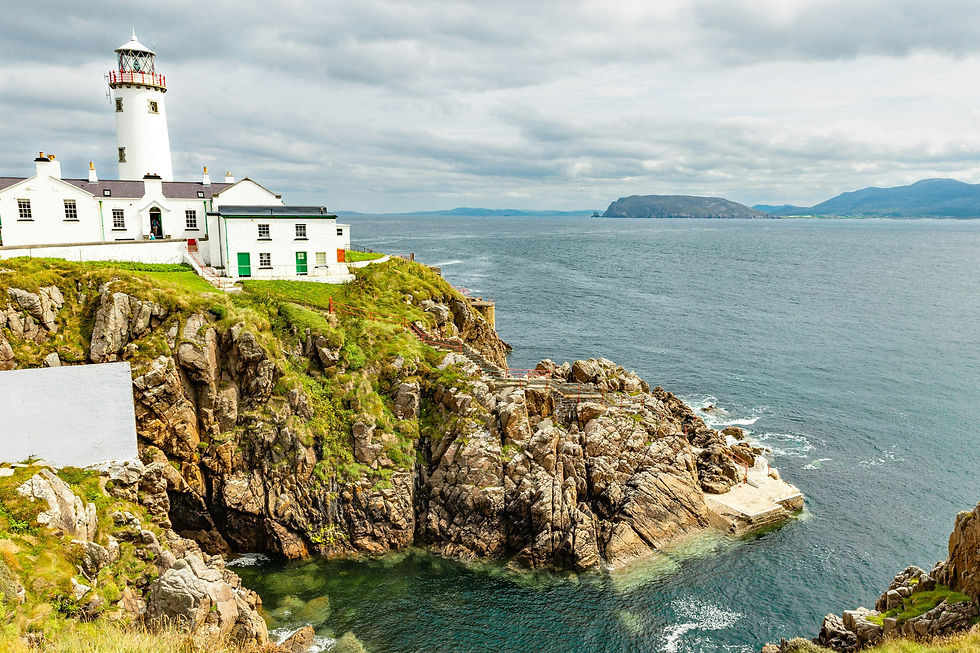
The lighthouse itself is available as self-catering accommodation now, which puts it on my list of places I will absolutely stay at before I die. The keeper’s cottage, the views, the sound of the sea at night, it’s the kind of thing you tell people about years later. (I would be too scared alone. We both are cats!)
Practically: It’s about 45 minutes north of Letterkenny. The road narrows considerably as you approach. Take your time and it’s fine.
Why it’s underrated: Donegal itself is undervisited compared to the rest of the route. Fanad is even further off the beaten path within Donegal. Most people see it in photographs, think “that looks nice,” and never make the detour. Please make the detour.
Hidden Gems Most People Drive Past
Beyond the stops already mentioned, these are the ones I always tell people about:
Skellig Michael, Kerry, A UNESCO World Heritage Site, a jagged rock rising out of the Atlantic, and a 6th-century monastic settlement that looks like it was carved by someone arguing with gravity. You need a boat and decent weather. Worth every bit of effort. Also, this is where scenes of the film Star Wars was filmed.

Achill Island, Mayo, Ireland’s largest island, connected by a bridge. Black cliffs, golden beaches, a deserted village on the mountain slope. Keem Bay has water the colour of the Mediterranean on a good day.
Lough Nafooey, Galway/Mayo border is a long, still lake hemmed in by mountains on both sides. Most people speed past on the road to Westport. Pull over. It’s the kind of view that stops a conversation dead.
Ballintoy Harbour, Antrim, Technically on the Causeway Coastal Route rather than the Wild Atlantic Way, but if you’re looping north through Donegal it’s worth the slight detour. You’ll recognise it as the Iron Islands from Game of Thrones. In reality it’s a tiny stone harbour with extraordinary atmosphere.
Maghera Beach & Caves, Donegal, Sea caves accessible at low tide, wild beach, almost no facilities, almost no crowds. Pure, untamed Atlantic coastline. Check tide times.
Practical Tips Before You Go
When to go: May - October is good, However, May and June are the sweet spot. Long evenings, reasonable weather, before peak season crowds arrive. September is also excellent, quieter, golden light, still warm enough.
Weather: Accept it. Ireland’s west coast weather changes in minutes. Pack layers, a decent waterproof, and a willingness to find a pub if it turns. Some of the best days I’ve had on this route started with rain and ended with a double rainbow over the Atlantic. That’s just Ireland.
Where to stay: Mix it up. A night in a proper Irish pub guesthouse, a night in a quirky B&B with a local host who knows every stop within 20 miles, a splurge night somewhere with a sea view. Trip.com fine here; availability gets tight in July/August so book ahead.
Connectivity: Mobile signal on the remote stretches can be patchy. Download Google Maps offline before you start. Screenshot the route sections you need. Don’t rely entirely on data.
Driving rules: Drive on the left. Speed limits are in km/h. Most rural roads are single-track with passing places and pull in, let the other car through, wave. It’s a system that works perfectly and strangers will appreciate you knowing it.
Petrol stations: Don’t let the tank drop below half on remote stretches, particularly in north Mayo and Donegal. Stations can be 40+ minutes apart.
What It’ll Cost You
Rough daily budget estimates in EUR (per person, based on two sharing):
Category | Budget | Mid-Range | Splurge |
Accommodation | €40–60 | €80–120 | €150–200+ |
Food & drink | €30–45 | €50–70 | €80–100+ |
Fuel (split two ways) | €15–20 | €15–20 | €15–20 |
Activities & entry fees | €10–20 | €20–40 | €40–60+ |
Daily total | €95–145 | €165–250 | €285–380+ |
The route itself costs nothing. The scenery is free. The pubs are reasonably priced by European standards. The main spend is accommodation and that varies wildly depending on whether you’re happy in a B&B or want a boutique hotel with an ocean view.
Activities worth paying for: Skellig Michael boat trip (€80–100pp), Aran Islands day trip from Doolin (€30–40pp), Cliffs of Moher visitor centre (€9pp), Blasket Islands boat (€35–45pp). Checkout a few activities here on GetYourGuide. If you would like to book any, just download the app using my link and use code ROAMMANTICS5 to get 5% discount. We get a small commission too, so it's a win-win.
The Honest Summary
The Wild Atlantic Way is one of those trips that earns its reputation in full. It’s not a road trip you do once and tick off. It’s one you do and then spend the next year thinking about the parts you missed, and the year after that planning how to go back.
Drive it slow. Stop when something catches your eye. Eat the seafood. Drink the Guinness. Talk to the person behind the bar.
And if you make it to Donegal, then don’t skip Fanad. I’ve never met anyone who went and didn’t come back changed, even just slightly.
That’s the thing about the edge of the world. It has a way of resetting you.
Have a question about any specific section of the route? Drop it in the comments. I read every one.


Comments